
Different Types of Curtain Styles: Rods, Tracks and Linings
Choosing curtains for a Dubai home or hospitality space means weighing several decisions at once: heading style, fabric weight, lining, hanging system, and how the finished panel behaves on a daily basis. Different types of curtains styles with curtain rod, tracks, motorised curtains with normal lining, blackout lining each solve a different combination of light, privacy, and appearance, and getting the pairing right is what separates a curtain that looks considered from one that simply hangs there. A well-specified curtain brings together the right heading, hardware, and lining so the finished window works as well as it looks, whether that means full blackout for a bedroom or a soft, light-filtering drape for a hotel lobby.
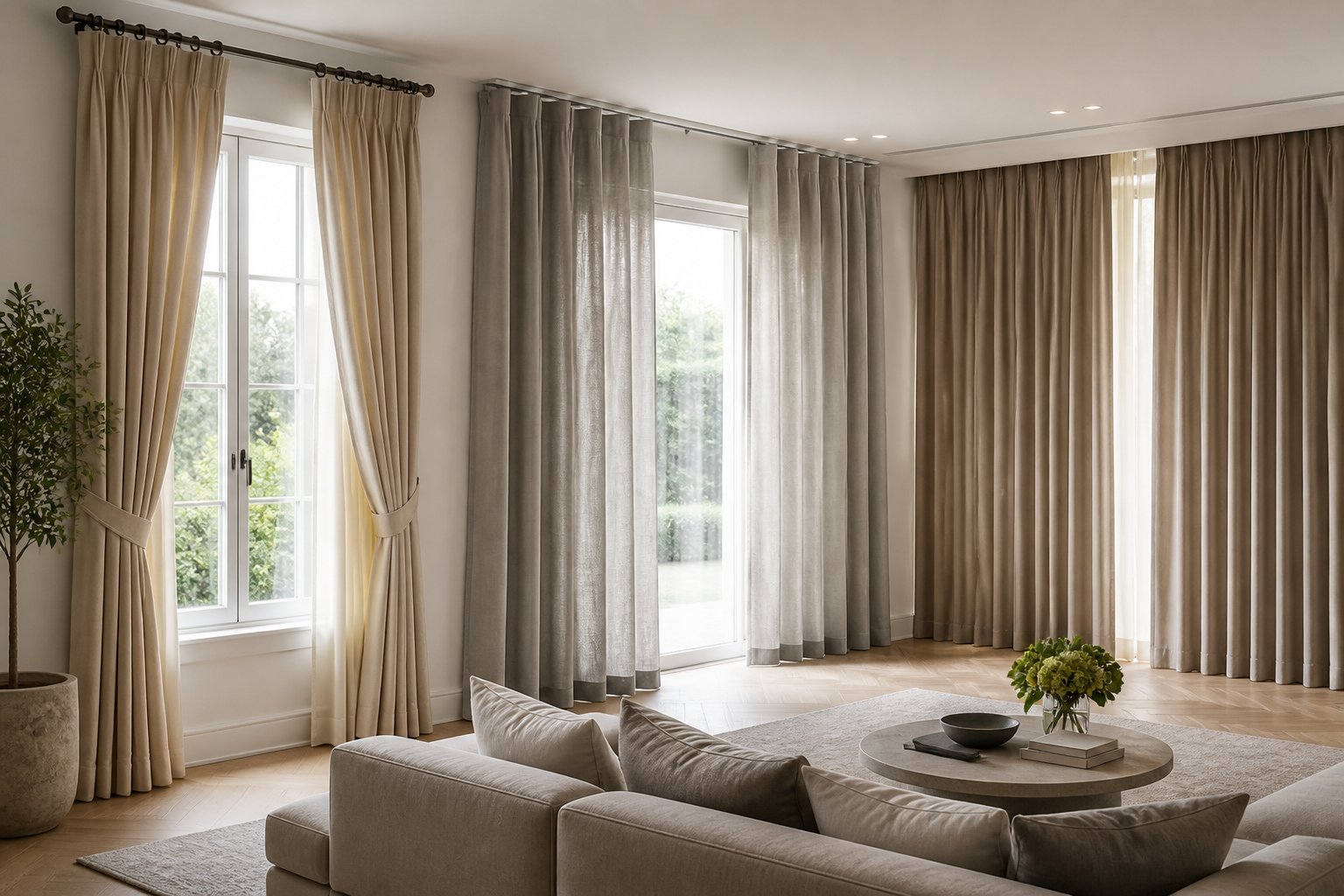
Full-height glazing, humidity, strong daylight, and the scale of villa and hotel windows across the city all shape which combinations perform well here. Evershine Furniture has worked on made-to-measure curtains, blinds, and upholstery for homes, hotels, and restaurants in Dubai since 2019, and that project experience sits behind the recommendations in this guide. Readers who want to talk through a specific window or room can reach the team directly once they have a clearer sense of what to ask for.
How to Choose the Right Curtain Combination
Curtain selection works best as one connected decision rather than a series of separate choices about fabric, heading, and hardware. The type of curtains suited to a media room with blackout needs looks nothing like the drapery suited to a bright, sheer-curtained breakfast nook, even if both use similar curtain fabrics on paper. Fabric weight, fullness, and the practical space behind the track all influence whether a finished pair of decorative curtains hangs cleanly or looks under-dressed.
Curtains vs. Drapes: What Is the Practical Difference?
In everyday Dubai usage, "curtains" and "drapes" describe the same product family, though drapes usually imply heavier, lined fabric and a more formal drapery style. Curtains can be lightweight and sheer or fully lined and structured. The distinction matters less than the fabric weight and lining chosen for the specific room.
What Should You Decide Before Choosing a Heading Style?
Before selecting a heading, settle on the room's light control needs, whether the curtains will be opened and closed daily, and whether the look should read as tailored and formal or relaxed and casual. A bedroom prioritising blackout performance calls for a different heading and lining than a living room where curtains stay mostly open. Single-panel curtains suit narrower windows, while layered curtains (a sheer plus a lined drape) suit rooms that need both daytime privacy and night-time blackout.
How Much Fullness and Stack-Back Space Do You Need?
Fullness refers to how much fabric is used relative to the track width, typically calculated as a ratio, and it directly affects how full and rich the finished curtain looks when closed. Higher fullness ratios need more stack-back space, meaning more wall space beside the window for the curtains to sit when fully open. Villas with tall, wide windows generally have room for generous fullness; apartments with narrow reveals need a more restrained ratio to avoid curtains overwhelming the space.
Curtain Headings and Decorative Styles Explained
The heading is the top edge of the curtain and it determines both the visual character of the panel and the hardware it needs. Structured pleats such as pinch, box, and goblet suit formal interiors and hospitality settings, while eyelet, tab-top, and rod pocket headings suit a more relaxed, contemporary look, and each heading pairs differently with curtain rods versus tracks.
Eyelet and Grommet Curtains for Easy Everyday Operation
Eyelet curtains (also called grommet curtains) have metal-ringed holes punched directly into the fabric top, which slides straight onto a rod. They glide smoothly, need no separate hooks or rings, and give a clean, modern fold. They work well in living rooms and bedrooms where curtains are drawn daily, though the fixed spacing of the eyelets limits fullness compared with pleated headings.
Ripple Fold Curtains for a Contemporary Tailored Look
Ripple fold curtains use a track-mounted carrier system that creates soft, even, wave-like folds across the full width of the panel. The look is streamlined and architectural, popular in modern villas and hotel public areas where a tailored, uncluttered appearance matters. Ripple fold requires a compatible track, not a rod, and tends to sit close to the wall with minimal stack-back.
Pencil, Pinch, Box, and Goblet Pleats for Structured Interiors
Pencil pleat curtains gather into narrow, uniform folds and suit both rods and tracks. Pinch pleat curtains group fabric into crisp double or triple folds stitched at intervals, giving a tailored, formal finish favoured in hotel suites and restaurant dining rooms. Box pleat curtains use flat, structured folds for a crisp, architectural line, while goblet pleat curtains form rounded, cup-like pleats padded to hold their shape, well suited to formal curtains in period-style or maximalist interiors.
Rod Pocket, Back Tab, Tab-Top, and Tie-Top Curtains
Rod pocket curtains have a sewn channel that the rod threads through directly, creating a soft, gathered look with no visible hardware. Back tab curtains use fabric loops sewn to the reverse, so the rod is hidden and the front face falls in smooth folds. Tab-top and tie-top curtains use visible fabric loops or ties over the rod, giving a casual, café-style appearance suited to relaxed living spaces rather than formal rooms.
Café Curtains, Valances, Swags, and Window Scarves
Café curtains cover only the lower half of a window, giving privacy while keeping the upper glass free for light, a practical option for street-facing kitchens. Valances and swags are decorative top treatments, either tailored (valance curtains) or draped (swag curtains), often used with window scarves to soften a plain track or rod and add a finished, layered look above tiebacks and full-length panels.
When to Use Curtain Rods, Tracks, and Motorised Operation
Curtain rods suit lighter fabrics and decorative headings on standard-width windows, while curtain tracks suit heavier lined curtains, wide spans, and ceiling-mounted installations, with motorised operation available on either but most practical on track systems. The choice of hardware should follow directly from the heading style and fabric weight already selected, not be decided separately.
When Does a Decorative Curtain Rod Make Sense?
A decorative curtain rod works well for standard-width windows dressed in lightweight to mid-weight fabric, particularly with eyelet, tab-top, tie-top, or rod pocket headings that are designed to sit directly on curtain rings or the pole itself. Rods bring a visible, finished element into the room, useful where the pole and finials are part of the design. Tension rods suit small, low-load applications like café curtains, not full-length lined drapery.
Why Are Curtain Tracks Preferred for Full-Height Windows?
Curtain tracks handle the weight of lined and blackout curtains more reliably across wide or full-height glazing, common in Dubai villas and hotel rooms with floor-to-ceiling windows. Tracks can be curved around bay windows or corners, run flush to the ceiling for a cleaner sightline, and support a traverse rod mechanism for smoother, cord-operated opening on wide spans. For heavy interlined drapery, a track distributes weight along gliders rather than relying on rings alone.
Which Curtain Styles Work Best With Each Hanging System?
Pencil pleat and pinch pleat curtains both perform well on tracks and can be adapted for rods with the right ring or hook attachment. Ripple fold curtains are track-specific. Eyelet curtains are rod-specific by design, since the fabric slides directly onto the pole.
| Heading Style | Rod-Compatible | Track-Compatible |
|---|---|---|
| Eyelet | Yes | No |
| Ripple Fold | No | Yes |
| Pencil Pleat | Yes | Yes |
| Pinch Pleat | With hooks | Yes |
When Are Motorised Curtains Worth Considering?
Motorised curtains suit wide spans, full-height glazing, and windows in awkward or hard-to-reach positions, where drawing heavy lined curtains by hand daily becomes impractical. Hotel suites and restaurant dining rooms benefit from consistent, effortless operation for staff and guests alike. Evershine Furniture advises on motorised options as part of a wider curtain and track specification, alongside fabric and lining selection.
Selecting Fabric, Lining, Length, and Layers
Fabric, lining, and length together determine how much light a curtain blocks, how it drapes, and how it reads within a room's proportions. These choices need to be made alongside the heading and hardware decisions already covered, since a heavy blackout lining changes the weight a track or rod must carry.
Normal Lining vs. Blackout Lining: Which Is Right for Your Room?
Normal lining adds body, improves drape, and offers moderate light filtering and some thermal buffering, suiting living rooms and dining spaces where daylight is welcome. Blackout lining adds a dense, light-blocking layer bonded or sewn to the back of the fabric, substantially reducing light and outside glare, which matters in bedrooms and media rooms. Blackout lining also adds noticeable weight, so it is often paired with track systems rather than lightweight rods.
Sheer, Blackout, and Thermal Curtains for Light and Privacy
Sheer curtains filter daylight softly while maintaining daytime privacy without full blackout, and pair well as a layer beneath heavier drapes. Blackout curtains use a dense lining, often paired with linen or cotton face fabric (blackout linen curtains), to reduce light entering a room, well suited to bedrooms. Thermal curtains use an insulating interlining to help buffer heat transfer at the glass, a relevant consideration given Dubai's strong daytime sun exposure.
How Curtain Length Changes the Proportions of a Room
Floor-length curtains that just clear the floor give a tailored, contemporary look and are the most practical length for daily use. Sill-length curtains (also called window sill curtains or apron curtains) suit kitchens and windows with furniture positioned directly below. Puddle-length curtains, where fabric pools on the floor, read as formal and decorative rather than functional, and work better in low-traffic reception areas than in daily-use rooms.
Using Linen, Pattern, and Layering Without Overwhelming the Space
Linen curtains bring a relaxed, textured finish that suits villa living rooms and bedrooms, though pure linen alone offers limited light control without a lining. Patterned curtains add visual interest but read best as a single statement layer rather than combined with multiple other patterns in the same room. Layered curtains, sheer plus lined drape, give flexibility between daytime light and night-time blackout, and a pelmet can conceal the track or rod where a fully finished, tailored ceiling line is wanted.
A Made-to-Measure Curtain Plan for Your Dubai Space
A workable curtain brief brings together heading, hardware, lining, and length into a single specification rather than four separate choices. For a Dubai bedroom needing genuine night-time darkness, that might mean pinch pleat curtains on a track with blackout lining, mounted close to the ceiling to minimise light gaps at the top. For a restaurant dining room, ripple fold curtains on a motorised track with normal lining might suit the daily operating rhythm better than a manually drawn rod.
Evershine Furniture works through this specification process with residential and hospitality clients across Dubai, drawing on broad fabric choices and experience fitting curtains, tracks, and blinds into full-height glazing, bay windows, and other challenging layouts. The team's installation work is regularly noted for being careful and tidy, with clear communication throughout the process. Anyone with a specific window, room, or project brief can visit the workshop in Al Quoz, near TGB, at Warehouse 5, 75 22nd Street, or call +971 4 338 0491 to talk through fabric samples and hardware options.
Conclusion
The right curtain combination for a Dubai window comes down to matching heading, hardware, lining, and length to how the room is actually used. Blackout lining on a track suits bedrooms needing genuine darkness; normal lining on a rod suits daylight-filled living spaces; motorised tracks earn their place on wide or hard-to-reach glazing. Working through these decisions together, rather than picking fabric first and hardware as an afterthought, produces a finished curtain that performs as well as it looks.
Frequently Asked Questions
What is the difference between normal lining and blackout lining?
Normal lining adds body and drape with moderate light filtering, suited to living rooms and dining areas. Blackout lining adds a dense layer that substantially reduces light and outside glare, making it the practical choice for bedrooms and media rooms. Blackout lining also adds weight, which can influence whether a rod or track is better suited to the finished curtain.
Which curtain styles work best with a track?
Pinch pleat, pencil pleat, and ripple fold curtains all work well on tracks, with ripple fold specifically designed for track-mounted carrier systems. Tracks suit heavier, lined, or blackout curtains and wide or full-height windows better than lightweight rods. Eyelet curtains are not track-compatible, since the heading is designed to slide directly onto a rod.
Are eyelet curtains suitable for blackout bedrooms?
Eyelet curtains can be made with blackout lining, but the fixed ring spacing limits fullness compared with pleated headings, which can leave small light gaps at the top and sides. For bedrooms needing consistent, edge-to-edge darkness, a pinch pleat or pencil pleat heading on a track, mounted close to the ceiling, gives tighter coverage. Eyelet with blackout lining still suits bedrooms where some light at the edges is acceptable.
Should curtains be mounted to the ceiling or above the window frame?
Ceiling-mounted tracks generally give better blackout performance and a taller, more tailored appearance, since they eliminate the light gap above the window frame. Mounting above the frame works for lighter, daytime-use curtains where full blackout is not the priority. Full-height villa and hotel windows benefit most from ceiling mounting.
Can motorised curtains be fitted on large or hard-to-reach windows?
Motorised curtains suit wide spans, full-height glazing, and windows positioned in awkward or hard-to-reach spots where manual operation is impractical daily. Motorisation is most commonly paired with track systems rather than rods. Evershine Furniture advises on motorised track options as part of a full curtain specification for residential and hospitality projects.
How do I choose the right curtain length for a living room?
Floor-length curtains that just clear the floor give a tailored, contemporary look and suit daily-use living rooms best. Sill-length works for windows with furniture positioned directly beneath them. Puddle-length is a decorative option better suited to low-traffic formal spaces than everyday living rooms.